The Bil Guide
Overview
Bil: an extension to Go for parallel processor systems.
Bil and Go both have concurrency models that are heavily inspired by Hoare’s CSP.
Go is a general-purpose language that borrows CSP’s channel-and-process ideas but relaxes them with buffering, dynamic concurrency, and conventional shared-memory mechanisms
Bil is a special-purpose language for parallel processor systems; influenced by CSP, by Go and by May’s occam. Built on the Go toolchain, it constrains and shapes the Go concurrency model to encourage a higher level of discipline as needed by parallel systems. Bil helps coders to reason about their process models and to selectively place processes on to physical processors.
flowchart TD
    CSP["CSP<br/>Hoare, 1978/85"]
    Newsqueak["Newsqueak<br/>Pike"]
    Go["Go<br/>2009"]
    occam["occam<br/>May"]
    Bil["Bil<br/>today"]

    CSP -->|1988| Newsqueak
    CSP -->|1983| occam
    occam --->|process model| Bil
    Newsqueak -->|Alef, Limbo| Go
    Go -->|syntax & tooling| Bil

    style Bil stroke:#e0a82e,stroke-width:3px
Bil is intended for parallel processor systems, but also efficiently supports single processor and multicore shared memory processor architectures for easier reasoning about concurrent code, software development and educational purposes. A Bil emulator (WASM) implements a parallel processor mesh to model and test massively parallel systems.
This document provides an introduction to the Bil language by way of a series of worked examples. Bil is a variant of the Go language and a working knowledge of Go is assumed.
Follow the installation and run code instructions in Getting Started to follow along on your own machine.
Table of Contents
- Section I: Introduction by Example
- Example 1: Two processes and a channel
- Example 2: Process declaration
- Example 3: Waiting on several channels
- Example 4: Skip and stop
- Example 5: Channel protocols
- Example 6: Replicated parallel (worker farm)
- Example 7: Data-parallel scatter/gather
- Example 8: Replicated alternation (many-to-one server)
- Example 9: Priority guards
- Example 10: Grid placement (mesh ripple)
- Section II: Theory of Operation
- Section III: Hinterland
- Section IV: Further Bil
Section I: Introduction by Example
Example 1: Two processes and a channel
A Bil process is a code unit that can be run in parallel with other processes. Processes can be run in any order. Processes can be run in parallel by placing them on multiple physical processors. Processes can be run concurrently on a single processor. Processes do not share memory. Processes may be nested.
A Bil channel is a unidirectional, bilateral process-to-process message passing interface. One process outputs data to a channel with <-, the other inputs data with ->. Channels are unbuffered: the sender blocks on output and the receiver blocks on input. Channels may be placed on physical point-to-point interprocessor links.
A seq {} block contains a list of expressions that are run in sequence. When a seq is entered, each expression is run in the specified order. When the last expression finishes, the block is done and the program proceeds.
A par {} block contains a list of expressions that are run in parallel. When a par is entered, a each expression is run independently on a dedicated thread with its own memory (a fork). When all expressions are finished, the block is done (a join) and the program proceeds.
In regular Go, processes (i.e. goroutines) can share memory freely with each other and channels can be buffered. In contrast, by avoiding shared memory dependencies and associated race conditions, Bil’s model facilitates the placement of parallel processes onto multiple physical processors (and channels to links) for large scale parallelism. When Bil parallel processes share a processor, they run concurrently as time-sliced threads (i.e. as isolated goroutines), taking advantage of multiple cores if available.
package main

func main() {
	c := make(chan int)

	par {
		seq {
			c <- 42
			c <- 99
		}
		seq {
			var x, y int
			c -> x
			c -> y
			println(x)
			println(y)
		}
	}
}
Topology
graph LR
    sender -->|c: int| receiver
Example 2: Process declaration
A Bil process can be declared with proc to indicate a code unit intended to be run as an independent process. A proc is analagous to a Go func and they may be mixed freely: a proc may call a func and a func may call a proc. Bil checks both proc and func blocks for the same parallel constraints.
package main

proc sender(c chan<- int) {
	c <- 42
	c <- 99
}

proc receiver(c <-chan int) {
	var x, y int
	c -> x
	c -> y
	println(x)
	println(y)
}

func main() {
	c := make(chan int)

	par {
		sender(c)
		receiver(c)
	}
}
Topology
graph LR
    sender -->|c: int| receiver
Example 3: Waiting on several channels
An alt {} block waits on whichever of several channel operations becomes ready first, then runs that one alternative.
package main

import "time"

proc server(request <-chan int, shutdown <-chan bool) {
	var x int
	var sd bool

	for {
		alt {
			request -> x {
				println(x)
			}
			time -> After(1 * time.Second) {
				println("tick")
			}
			shutdown -> sd {
				if sd {
					return
				}
			}
		}
	}
}

func main() {
	request  := make(chan int)
	shutdown := make(chan bool)

	par {
		server(request, shutdown)
		seq {
			request  <- 1
			request  <- 2
			time.Sleep(3 * time.Second)
			request  <- 3
			shutdown <- true
		}
	}
}
Running it: prints 1, 2, tick, tick, 3, then exits cleanly.
Topology
graph LR
    driver -->|request: int| server
    driver -->|shutdown: bool| server
    timer -.->|timeout| server
Example 4: Skip and stop
Bil implementaion of occam’s useful pair: skip terminates immediately (does nothing, succeeds); stop never terminates (deliberate, inert halt). A skip {} block acts as the default guard for an alt - if no channel is ready, then the skip blocks is executed.
package main

import "time"

proc poller(c <-chan int) {
	var x int
	for {
		alt {
			c -> x {
				if x >= 0 {
					println(x)
				} else {
					stop
				}
			}
			skip {
				println("skip")
			}
		}
		time.Sleep(100 * time.Millisecond)
	}
}

proc sender(c chan<- int) {
	time.Sleep(150 * time.Millisecond)
	c <- 42
	time.Sleep(150 * time.Millisecond)
	c <- -1
}

func main() {
	c := make(chan int)

	par {
		poller(c)
		sender(c)
	}
}
Topology
graph LR
    sender -->|c: int| poller
Example 5: Channel protocols
Typed, structured messages over a channel, including variant/tagged protocols dispatched with a plain Go type-switch. Everything sent so far has been a bare int/bool; first example needing compound data and message-shape checking. Two independent demos: a Point protocol (X, Y sent together as one atomic message) shows the plain structured case; a LogMsg protocol (tagged Info/Warn, each carrying an INT) shows the variant case.
package main

type Point struct {
	X, Y int
}

type LogMsg interface {
	isLogMsg()
}

type Info struct {
	Code int
}

func (Info) isLogMsg() {}

type Warn struct {
	Code int
}

func (Warn) isLogMsg() {}

proc pointSender(out chan<- Point) {
	out <- Point{X: 1, Y: 2}
	out <- Point{X: 3, Y: 4}
}

proc pointReceiver(in <-chan Point) {
	var p Point
	for range 2 {
		in -> p
		println(p.X, p.Y)
	}
}

proc logSender(out chan<- LogMsg) {
	out <- Info{Code: 1}
	out <- Warn{Code: 2}
	out <- Info{Code: 3}
}

proc logReceiver(in <-chan LogMsg) {
	for range 3 {
		switch in :-> v.(type) {
		case Info:
			println("info", v.Code)
		case Warn:
			println("warn", v.Code)
		}
	}
}

func main() {
	points := make(chan Point)
	par {
		pointSender(points)
		pointReceiver(points)
	}

	logs := make(chan LogMsg)
	par {
		logSender(logs)
		logReceiver(logs)
	}
}
Running it prints 1 2, 3 4, info 1, warn 2, info 3 — deterministically.
Topology
graph LR
    pointSender -->|points: Point| pointReceiver
    logSender -->|logs: LogMsg| logReceiver
Example 6: Replicated parallel (worker farm)
par i := range N {} denotes a replicated parallel — an array of identical worker processes over an array of channels. A farmer distributes one item to each of N workers, then collects the N results in order — the whole thing is a complete runnable program.
package main

const N = 3

proc worker(in <-chan int, out chan<- int) {
	var x int
	in -> x
	out <- x * x
}

func main() {
	toWorker := makeChans[int](N)
	fmWorker := makeChans[int](N)

	par {
		par i := range N {
			worker(toWorker[i], fmWorker[i])
		}
		seq {
			for i := range N {
				toWorker[i] <- i + 1
			}
			for i := range N {
				println(<-fmWorker[i])
			}
		}
	}
}
Running it prints 1, 4, 9 — deterministically: the collecting loop reads fmWorker[0], then [1], then [2] in that fixed order, and each read just blocks until that specific worker’s unbuffered send is ready, regardless of which worker actually finishes first.
Topology
graph LR
    farmer -->|toWorker0: int| w0["worker[0]"]
    farmer -->|toWorker1: int| w1["worker[1]"]
    farmer -->|toWorker2: int| w2["worker[2]"]
    farmer -.- dots(["..."])
    w0 -->|fmWorker0: int| farmer
    w1 -->|fmWorker1: int| farmer
    w2 -->|fmWorker2: int| farmer
Example 7: Data-parallel scatter/gather
Split an array across replicated workers, each computes a partial result, fan back in and combine. A genuine parallel algorithm. N = 4 workers each sum their own chunk of a 12-element array; a gather step sums the 4 partial sums into a total. Deliberately flat, not recursive, built with a splitN to produce disjoint chunks of the data array plus a replicated par and a self-calling proc.
package main

const n = 4

proc worker(chunk []int, result chan<- int) {
	sum := 0
	for _, v := range chunk {
		sum += v
	}
	result <- sum
}

func main() {
	data := []int{1, 2, 3, 4, 5, 6, 7, 8, 9, 10, 11, 12}
	chunks := splitN(data, n)
	results := makeChans[int](n)

	par {
		par i := range n {
			worker(chunks[i], results[i])
		}
		seq {
			total := 0
			for i := range n {
				var partial int
				results[i] -> partial
				total += partial
			}
			println(total)
		}
	}
}
Running it prints 78 (1+2+…+12) — deterministically.
Topology
graph LR
    data -->|chunk0| w0["worker[0]"]
    data -->|chunk1| w1["worker[1]"]
    data -->|chunk2| w2["worker[2]"]
    data -->|chunk3| w3["worker[3]"]
    w0 -->|result0| gather
    w1 -->|result1| gather
    w2 -->|result2| gather
    w3 -->|result3| gather
Example 8: Replicated alternation (many-to-one server)
alt _ := range nClients — one process listening across N channels at once. nClients = 3 clients each send perClient = 2 requests on their own channel; one server process alts across all 3 channels at once, printing whatever arrives, until it’s received all 6 — a many-to-one fan-in. v below is bound with :->, not -> — a replicated alt guard takes the same declare-vs-assign choice as any other receive (see the alt reference section), and :-> is what lets v be introduced right here instead of needing a var v int above the loop.
package main

const nClients = 3
const perClient = 2

proc client(id int, out chan<- int) {
	for i := range perClient {
		out <- id*100 + i
	}
}

proc server(chans []chan int) {
	for range nClients * perClient {
		alt _ := range nClients {
			chans[_] :-> v {
				println(v)
			}
		}
	}
}

func main() {
	chans := makeChans[int](nClients)
	par {
		par i := range nClients {
			client(i, chans[i])
		}
		server(chans)
	}
}
Running it: 6/6 runs checked, content always exactly {0, 1, 100, 101, 200, 201} (each client’s two values, id*100+i) — order genuinely varies run to run, same non-determinism class as dining philosophers — real concurrent contention for server’s attention.
Topology
graph LR
    client0 -->|chans0| server
    client1 -->|chans1| server
    client2 -->|chans2| server
Example 9: Priority guards
Priority-ordered guard selection. Regular alt (like Go’s select) picks pseudo-randomly among ready cases with no priority concept. The keyword combination pri alt {} denotes a specialized alt {} block where the order of branches set’s the priority of each branch.
Here, server drains a high channel before ever touching low when both are ready — a highSender and lowSender each send TOTAL = 5 values concurrently, and server must always prefer high.
package main

import "time"

const total = 5

proc highSender(high chan<- int) {
	for i := range total {
		high <- i
	}
}

proc lowSender(low chan<- int) {
	for i := range total {
		low <- i
	}
}

proc server(high <-chan int, low <-chan int) {
	for range 2 * total {
		time.Sleep(5 * time.Millisecond)
		pri alt {
			high -> _ {
				println("high")
			}
			low -> _ {
				println("low")
			}
		}
	}
}

func main() {
	high := make(chan int)
	low := make(chan int)
	par {
		server(high, low)
		highSender(high)
		lowSender(low)
	}
}
Running it: 5/5 runs, exactly high × 5 then low × 5, every time, exit 0. Confirmed this by running the identical scenario with plain alt instead: genuinely random ordering, one run even came back low × 5 then high × 5, the exact opposite of intended priority — proving Go’s select really doesn’t favor either side, so the ordering seen with pri alt isn’t circumstantial. Adding a 5ms sleep before every server iteration gives both senders time to actually be blocked-and-ready before the check happens, and with that, priority holds 5/5 — the sleep isn’t part of what pri alt does, it’s what the test needed to reliably force genuine contention.
Topology
graph LR
    highSender -->|high: int| server
    lowSender -->|low: int| server
Example 10: Grid placement (mesh ripple)
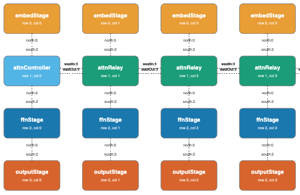
Let’s leave a single machine’s goroutines behind and place processes onto physically separate processors. This one runs on Bil’s own WASM-worker grid emulator (other emulators are available), a real NxM array of nodes, each an isolated Web Worker wired to its four nearest neighbours (N/E/S/W) by physical, blocking point-to-point links (bilink) rather than on processor channels. placed par replaces par here: its processor(...) clauses place channel parameters onto physical links and then calls a top level proc for that processor.
A counter ripples east along every row from origin (column 0), forwarded hop-by-hop by relay (every other column, wildcarded with processor(*, *) so the same code runs identically on every row — row never matters here, the ripple on each row is independent), reflects at the last column (reflect), and ripples back west the same way. waves = 3 full round trips.
package main

const waves = 3

proc origin(eastOut chan<- int32, eastIn <-chan int32) {
	for wave := range waves {
		eastOut <- int32(wave)
		eastIn -> _
	}
}

proc reflect(westIn <-chan int32, westOut chan<- int32) {
	for wave := range waves {
		westIn :-> v
		westOut <- v
	}
}

proc relay(westIn, eastIn <-chan int32, eastOut, westOut chan<- int32) {
	for wave := range waves {
		westIn :-> v
		eastOut <- v

		eastIn :-> v2
		westOut <- v2
	}
}

func main() {
	cols := bilink.NumCols()

	placed par {
		processor(*, 0) {
			place eastOut at link[1].out
			place eastIn at link[1].in
			origin(eastOut, eastIn)
		}
		processor(*, cols-1) {
			place westIn at link[3].in
			place westOut at link[3].out
			reflect(westIn, westOut)
		}
		processor(*, *) {
			place westIn at link[3].in
			place eastIn at link[1].in
			place eastOut at link[1].out
			place westOut at link[3].out
			relay(westIn, eastIn, eastOut, westOut)
		}
	}
}
Running it: bil emu examples/10-mesh-ripple.bil builds and serves the grid emulator, auto-sizing the grid so every placed role gets its own node, then opens it in a browser. Unlike Examples 1–9, there’s no terminal output to check byte-for-byte — the ripple plays out purely as link activity on the grid page, 3 full round trips east then west on every row. The channels here carry int32, not the plain int every earlier example used: place rewrites each send/receive straight to bilink.Send/Recv, and those are hardcoded to int32 (the physical link primitive moves one 32-bit word per round trip), so a placed channel’s element type has to match exactly for the generated code to type-check.
Topology
graph TB
    subgraph row0["row 0"]
        direction LR
        o0["origin"] <-->|link1/link3| r0["relay"] <-->|link1/link3| d0["···"] <-->|link1/link3| f0["reflect"]
    end
    subgraph row1["row 1"]
        direction LR
        o1["origin"] <-->|link1/link3| r1["relay"] <-->|link1/link3| d1["···"] <-->|link1/link3| f1["reflect"]
    end
    subgraph rowN["row N-1"]
        direction LR
        oN["origin"] <-->|link1/link3| rN["relay"] <-->|link1/link3| dN["···"] <-->|link1/link3| fN["reflect"]
    end
    row0 ~~~ row1 ~~~ dotsRow["⋮"] ~~~ rowN
Section II: Theory of Operation
Getting Started
Build the bil tool once (cd tools/bil && go build -o bil .), then run a .bil file with:
tools/bil/bil run examples/01-twoprocs.bil
bil run chains together Bil’s two internal tools, failing at the first step that doesn’t pass rather than running anything it hasn’t checked:
tools/bilc— a source-to-source preprocessor (a transpiler) that usesgo/scannerandgo/tokento parse Bil code, apply certain heuristic rules and to provide a set of helper functions. Finally, it usesgo/formatto translate the.bilfile into legal Go.tools/vet— ago/ast/go/types-based static analyzer that checks the transpiled Go against Bil’s usage rules (for example: a channel may only be used for input in oneparbranch, and output in one other). A violation is reported and the program is not run;bilcembeds//linedirectives in the transpiled Go mapping it back to the original.bilfile and line, so reported positions — and anygo runcompile error or panic — name the.bilsource, not the generated Go.- Only if that passes: calls
go runon the transpiled Go.
To run steps 1–2 only, without executing the program, use bil vet instead of bil run.
Install
Bil needs a Go toolchain on PATH at runtime - get Go from https://go.dev/dl/ if you don’t already have it.
On macOS, Linux, etc.:
curl -fsSL https://bil-lang.org/install.sh | sh
On Windows (PowerShell):
irm https://bil-lang.org/install.ps1 | iex
These install a prebuilt bil binary for your platform, and place it on your PATH.
Run Bil code
Run a .bil file with:
bil run examples/01-twoprocs.bil
bil run chains together Bil’s two internal tools:
tools/bilc— a source-to-source preprocessor (a transpiler) that usesgo/scannerandgo/tokento parse Bil code, apply certain heuristic rules and to provide a set of helper functions. Finally, it usesgo/formatto translate the.bilfile into legal Go.tools/vet— ago/ast/go/types-based static analyzer that checks the transpiled Go against Bil’s usage rules (for example: a channel may only be used for input in oneparbranch, and output in one other).- Only if that passes: calls
go runon the transpiled Go.
To run steps 1–2 only, without executing the program, use bil vet instead of bil run.
Editor support
There’s no dedicated .bil grammar yet, but since Bil is close enough to Go syntactically, telling your editor to highlight .bil files as Go gets you most of the way there. In VSCode, add this to settings.json (workspace or user): "files.associations": { "*.bil": "go" }. This just picks the highlighter — it doesn’t run gofmt/gopls against .bil files, since they aren’t valid Go until bilc rewrites them. Other editors / IDEs will have similar settings.
Run tests
cd tools/bilc
go test ./...
This runs tools/bilc/bilc_test.go against the fixtures in tools/bilc/testdata/: ok/*.bil files are transpiled, run, and checked against a matching *.golden file; err/*.bil files are checked to fail with an error containing the matching *.err file’s text. To add a regression test, drop a new .bil + .golden (or .err) pair into the right directory — no test code to touch.
ok/*.bil fixtures need deterministic output, since they’re checked with an exact string match. An example whose output is inherently timing-dependent (e.g. examples/03-server-alt.bil, which races a timer against a sleep) is deliberately left out of testdata/, and is only meant to be run manually via bil run.
tools/vet and tools/bil have their own go test ./... suites, run the same way from within each directory.
Build from source
To build it from source instead:
cd tools/bil && go build -o bil . && cd ../..
(the examples assume bil is on PATH; if you built from source without moving the binary, run tools/bil/bil in its place)
Bil Features
Bil includes a preprocessor (bilc) that converts Bil code (.bil) to Go code (.go) to introduce selected parallel programming features into a modern Go setting. Almost all Go features are preserved in the Bil programming model (types, control flow, expressions, structs, functions, etc.), with the notable exceptions of go (i.e. to start a goroutine) and buffered chans. These are replaced by an occam-style Communicating Sequential Parallel (CSP) model which reshapes go operations to par blocks and performs blocking input and output via unbuffered chans.
General
The following keywords are provided by Bil:
par
Runs its branches as concurrent goroutines and joins on completion. A static par{A B} becomes par(func(){A}, func(){B}); the replicated form par VAR := range N {X} becomes parFor(N, func(VAR int){X}), one goroutine per index.
seq
Wraps a block to indicate a par branch’s own sequential body — sugar for a bare {...} block (seq{X} → {X}), provided for readability rather than semantic necessity, since Go statements already execute sequentially by default.
chan -> and chan :->
Receive sugar for chan, read left-to-right like occam’s ?. Two forms, mirroring Go’s own =/:= split for a channel receive:
c -> xisx = <-c— assign.xmust already be declared.c :-> xisx := <-c— declare.xis introduced right here, and must not already be declared.
Either form takes an optional comma-ok suffix, mirroring Go’s own two-value channel receive: e.g. c -> x, ok is x, ok = <-c. Either form takes the Go idiomatic _ also. Either form generalizes to a receive on a method/function call when the right side is call-shaped (c -> Method(args) → <-c.Method(args), e.g. time -> After(d)). :-> also can be used in a type-switch guard: switch c :-> v.(type) { case T1: ...; case T2: ... } is switch v := (<-c).(type) { ... }, v a fresh binding as usual.
proc
An alias for Go’s func to indicate a code unit that is intended to be run as an independent process, provided for readability rather than semantic necessity. Bil checks both proc and func blocks for the same parallel constraints.
alt
Waits on whichever of several channel operations becomes ready first, then runs that one branch — occam’s ALT, rewritten to Go’s select. Guards read left-to-right (chan -> target { body } or chan :-> target { body }, echoing occam’s chan ? x) rather than Go’s case x := <-chan:; a (cond) && prefix gives a conditional guard, and VAR := range EXPR {...} gives the replicated form (one process listening across a runtime-sized set of channels, via altN). The bind target’s ->/:-> choice (see ##### chan -> above) is the same in every one of these shapes — plain, conditional, or replicated — including the replicated form, where only VAR (the winning replica index) is always fresh; that’s a property of altN’s runtime dispatch, not of which arrow the bind target uses. A bare select is rejected at compile time — alt/pri alt are the only supported forms, since they enforce the input-guard-only discipline (see the buffer-process example below) that a hand-written select could otherwise slip past.
pri alt
Like alt, but guards are tried in priority order — the first ready one wins, even if a lower-priority one is also ready. Go’s select has no priority concept, so this desugars to a cascade of nested selects, one per priority level, instead of a single one.
skip and stop
Bil implementaion of occam’s useful pair: skip terminates immediately (does nothing, succeeds); stop never terminates (deliberate, inert halt).
A skip {} block also acts as the default guard for an alt - if no channel is ready, then the skip blocks is executed. A skip statement simply gets dropped.
stop rewrites to time.Sleep(1<<63 - 1) rather than select{}, since Go’s runtime treats select{} as provably permanent and panics if it’s ever the last live goroutine; a pending timer isn’t, so it can sit there indefinitely without crashing.
Placement
placed par
Like par, but its branches are processor(...) clauses that specify the proc to be run on each processor. A placed proc may only take chan and compile-time constant parameters. Nesting placed par isn’t allowed. A given proc may be placed-called from at most one clause in the whole block. Where vars are declared in an outer scope, they must be read-only in all branches. timers may be declared in an outer scope and used in multiple branches, but they will not be synchronised across branches.
processor
Specifies a physical processor and must contain exactly one proc call. processor(id) matches by flat ID; processor(row, col) matches by grid position, and either slot may be the literal wildcard * (processor(1, *) matches every column of row 1; processor(*, *) matches every node and must be the block’s last clause). The body may be an if/else chain instead of one bare call, letting a single processor(...) dispatch further on another runtime condition.
place
Binds one of a placed-called proc’s own directional channel parameters to a physical point-to-point link, written at the call site: place eastOut at link[1].out; controller(eastOut). Every channel parameter must be bound by exactly one place statement, and must be declared with an explicit direction (e.g. proc controller(eastOut chan<- int)).
what bilc does with placement…
A .bil source file expresses placement with two constructs: a placed par { processor(...) {...} ... processor(*, *) {...} } block naming which role runs where, and place NAME at link[EXPR].in/.out statements in the calling clause binding one of that role’s own declared channel parameters to a physical link. bilc’s action on these two constructs is two rewrites, a set of structural requirements it enforces around them, and two generated artifacts.
Rewrite 1 — placed par becomes a runtime switch. Each processor(id) clause becomes case bilink.ID() == id:; each processor(r, c) clause becomes case bilink.Row() == r && bilink.Col() == c:. Either slot of the two-arg form may instead be a literal * wildcard: processor(1, *) matches every column of row 1 and compiles to just case bilink.Row() == 1: (only the pinned dimension is compared); processor(*, 0) matches every row’s column 0 and compiles to case bilink.Col() == 0:. A clause that wildcards both dimensions — processor(*) or processor(*, *) — matches every node and compiles to Go’s own default:, and must be the block’s last clause, since nothing after it could ever be reached (the fully-wild clause always runs last regardless of where it’s written, exactly like Go’s own default:, so a later clause after it could never be reached). A clause’s body may itself be an if/else chain rather than one bare call — each branch (recursively) either another if/else or a place-decls-then-one-call leaf — letting one processor(...) clause dispatch further by some other runtime condition (bilink.Row() == 0, say). The result is one ordinary switch {} in the compiled program — never a par(...), never goroutines. Every node’s Worker runs the exact same compiled program; which branch a given node takes depends entirely on bilink.Row()/Col()/ID().
Rewrite 2 — place NAME at link[EXPR].in/.out becomes nothing at all. It’s compile-time-only, and it lives at the call site, not inside the called proc’s own body: a proc declares ordinary directional Go channel parameters (eastOut chan<- int32), and the processor(...) clause that calls it writes place eastOut at link[1].out; controller(eastOut) to bind that parameter. Every reference to eastOut inside controller’s own body is rewritten straight to the equivalent bilink.Send/Recv call on link 1 — the Go channel value is never actually touched — so the call site itself passes a bare nil for that argument (controller(nil)), just enough to satisfy Go’s own type-checker. The .in/.out suffix is documentation only: it says which half of the physical link this name is for, right next to the index itself, rather than leaving a reader to infer direction solely from which of the callee’s two parameters this name happens to be passed to. bilc parses and discards it — it’s never cross-checked against the callee’s declared parameter direction, since a real check would just be re-deriving what that parameter’s own type already guarantees at compile time via Go’s own type-checker.
Artifact 1 — one standalone Go source per role. RoleBinaries emits roles/<name>/main.go for every distinct proc a placed par block calls — the whole file, unchanged, compiles to a single hardcoded call to just that one role instead of the switch. Every other declaration is still emitted exactly as normal; Go’s own linker, not bilc, eliminates whatever dead code is not reachable from that one call. Each binary only contains relevant code for that processor.
Artifact 2 — roles/placement.json manifest. Every reachable leaf with that leaf’s clause match, its ordered chain of if/else conditions, the proc it calls, and that call’s link-index binds. That allows the loader to target topologies without prior knowledge of the size of the processor network. The tools/placement2svg/placement2svg.py script is provided to make pretty pictures.
 placed par {
      processor(*, *) {
          if r == 0 {
              head()
          } else {
              idle()
          }
      }
  }
{
	"transport": "message-channel",
	"leaves": [
		{
		"match": { "default": true },
		"conditions": [{ "expr": "r == 0", "negate": false }],
		"proc": "head"
		},
		{
		"match": { "default": true },
		"conditions": [{ "expr": "r == 0", "negate": true }],
		"proc": "idle"
		}
	]
}
Helpers
The following helper funcs are provided by Bil as a built in “how to” correctly split an Array for distribution across a replicated par. Source code is shown here, which may be coped into your own splitter func as needed:
splitN
Splits a slice into n disjoint chunks (any remainder folded into the last one), chunks := splitN(data, n) — the one sanctioned way to divide a shared array across par branches. Chunks are views into the same backing array, not copies; each chunk’s disjointness from every other is proven once, by vet’s regions.go, rather than trusted or re-derived by hand at every call site.
func splitN[T any](s []T, n int) [][]T {
	chunk := len(s) / n
	out := make([][]T, n)
	for i := range n {
		lo := i * chunk
		hi := lo + chunk
		if i == n-1 {
			hi = len(s)
		}
		out[i] = s[lo:hi:hi]
	}
	return out
}
splitN2D
The 2D counterpart of splitN — splits a matrix ([][]T) into an nr×nc grid of rectangular tiles, tiles := splitN2D(matrix, nr, nc), each tiles[i][j] proven disjoint from every other tile by vet’s grid.go. A separate function, not a variadic extension of splitN: Go generics can’t unify a 1D and 2D splitter behind one signature, since the input type itself changes shape with dimensionality ([]T vs [][]T), not just a type parameter.
func splitN2D[T any](m [][]T, nr, nc int) [][][][]T {
	rchunk := len(m) / nr
	cchunk := len(m[0]) / nc
	out := make([][][][]T, nr)
	for i := range nr {
		r0 := i * rchunk
		r1 := r0 + rchunk
		if i == nr-1 {
			r1 = len(m)
		}
		out[i] = make([][][]T, nc)
		for j := range nc {
			c0 := j * cchunk
			c1 := c0 + cchunk
			if j == nc-1 {
				c1 = len(m[0])
			}
			tile := make([][]T, r1-r0)
			for r := r0; r < r1; r++ {
				tile[r-r0] = m[r][c0:c1:c1]
			}
			out[i][j] = tile
		}
	}
	return out
}
Bil Checks
Bil provides an occam-style Communicating Sequential Parallel (CSP) model where parallel processes can be configured to run as concurrent routines on a single processor, or alternatively as parallel routines spread over multiple physical processors with no shared memory that communicate over bilateral links.
Since the branches of a par cannot be guaranteed to have shared memory, the Bil transpiler performs a number of checks across par branches to flag code that depends on shared memory, for a pointer declared in an outer scope (a free variable) cannot be passed into a func in more than one branch.
Six checks are done:
par chans
- Each
chanimplements a bilateral communication between two parallelprocs. Achanis unidirectonal: oneprocmay use it for output and oneprocfor input.
par vars
varswhich are written in one process of a parallel may not be read by another process in the parallel. Avarcan be used read-only in multipleprocs in a parallel if none of theprocs write to it.
par refs
- Reference types -
pointers,maps,interfaces — collapse to one shared rule: a free variable of one of these types touched (any way — read, write, whatever) by more than oneprocof the same parallel is rejected outright. Confined to a single branch is still fine since no concurrent access is possible.
par arrays
- Elements of an array may be written in more than one branch of a parallel if the array subscripts used in each such branch select disjoint parts of the array.
par timers
- Any
timechannel can be used for input on mutiple par branches.
placed par
- Each branch takes one placed
proc. Every channel parameter of theprocmust be explicitly directional (<-chan T/chan<- T) and bound with aplacestatement; every non-channel parameter must be a compile-time constant. Nestingplaced parstatements isn’t allowed. A givenprocmay be placed-called from at most one clause in the whole block. Wherevars are declared in an outer scope, they must be read-only in all branches.
AI Cheatsheet
Bil is niche enough that most AI coding assistants have never seen it and will confidently write Go-with-buffered-channels-and-go-statements instead of real Bil. docs/ai-cheatsheet.md is a compact, self-contained reference — the ~10 new keywords, the 7 compiler-enforced safety rules, and 5 minimal worked patterns, framed as a delta from Go with a hint of occam, so it leverages the Go and occam knowledge every mainstream model already has.
How to use it: paste the whole file as the first message of a chat (or into a persistent system/custom-instructions slot, or as an attached file) before asking for Bil code — front-loading it is what actually grounds the model. For agentic tools with shell access (Claude Code, Cursor, etc.), it’s discoverable directly from the repo and pairs with bil vet, which gives a real, automated feedback loop the cheatsheet alone can’t: it transpiles and statically checks a .bil file against all 7 rules without running anything, so a tool-using AI can self-correct instead of guessing.
Section III: Hinterland
The Bil Project
This project, hosted at https://github.com/bil-lang consists of several, related components:
- Language & compiler frontend […/bil]
- Source code transpiler
- preprocessor that parses
.bilfiles and generates standard.gocode - includes helper Go functions and checks via syntax heuristics - Static analyser (AST-level)
- compiler-checked alias/usage safety across
proc/parargs - concurrent branches never share mutable memory
- Editor tools
- LSP (VS Code) extensions [tbd]
- other editor support (IntelliJ, emacs, vim…)
- Emulator & tooling […/emu]
- Emulator
- WASM webpage
- QEMU mesh [tbd]
- Docker mesh [tbd] - Topology tool (processor → host; channel → link) - Bootstrap & loader
- Runtime [tbd]
- Nano kernel (“Bil scheduler”)
- Footprint tool
- General information […/web]
- Website
Contributions are very welcome, preferably via a Pull Request. Please open an Issue if you would like to propose a new component.
Bil Rationale
Go’s channels/goroutines are compromised CSP, and that’s exactly the gap Bil exists to close
Two separate ways vanilla Go diverges from real CSP, not one:
- Buffering breaks the rendezvous. occam has no buffered channels — every communication is a synchronous handshake, sender and receiver both present at the same instant, which is the actual object CSP’s process algebra reasons about (traces/failures/refinement, deadlock-freedom proofs).
make(chan T, N)decouples send from receive in time — a channel plus an implicit buffer process, a weaker object than what CSP theory analyzes. This is why Bil makes “channels are always unbuffered” a hard rule rather than trusting Go’s default: vanilla Go doesn’t give you the rendezvous property for free, it has to be taken back by force. - Goroutines are shared-memory-native, not distribution-native. occam processes are safely movable onto physically separate processors with disjoint memory specifically because the compiler proves no concurrently-running branch can alias mutable state with another. Goroutines get none of that: they share the whole address space by default, any closure can capture any pointer, and the only backstop is the race detector — dynamic, and it only catches races that actually fire during an instrumented run. That’s a shared-memory-multicore design (the M:N scheduler exists to pack goroutines onto cache-coherent cores), not a distributed one.
Rob Pike’s “Share Memory By Communicating” (Further reading) is honest read as idiom advice — prefer a channel over a mutex-guarded variable when it reads better — but that’s a style recommendation a stray pointer can violate at any time, not a structural guarantee the compiler enforces. Bil’s version of the same sentence is a checked invariant, not a tip.
Bil and Go
Differences
Go’s concurrency model was heavily inspired by Hoare’s CSP. Bil’s model is different. It is inspired by the occam language CSP model. The main differences are:
| Topic | Bil: Parallel CSP Style | Go: Multicore CSP Style |
|---|---|---|
| Purpose | Designed specifically for parallel processor systems. | General-purpose programming language with CSP-inspired concurrency. |
| Processes | Processes are language-level constructs with explicit parallel composition (par). |
Goroutines are lightweight functions started with go. |
| Channels | Channels are usually statically declared and form explicit communication topologies. | Channels can be assigned, passed around, stored in data structures, and dynamically connected. |
| Communication | Strict synchronous rendezvous communication. Sender and receiver must meet. | Supports both synchronous (unbuffered) and asynchronous (buffered) channels. |
| Choice / Guarding | Uses alt for deterministic or nondeterministic guarded choice. |
Uses select, which chooses among ready communication operations. |
| Process Creation | Process structure is typically known statically. | Goroutines can be created dynamically at runtime in large numbers. |
| Scheduling | Processes are constrained goroutines which can be placed on independent processors. | Goroutines are multiplexed by the Go runtime scheduler onto OS threads. |
| Shared Memory | Strong emphasis on communication-only interaction. | Encourages channels, but shared memory with mutexes and atomics is fully supported. |
| Type System | Uses Go type system and adds channel protocols. | Modern general-purpose type system with interfaces, generics, libraries, etc. |
| Formal Correspondence to CSP | Very close to CSP’s process algebra origins. | CSP-inspired but pragmatic; many language features fall outside classical CSP. |
Conceptually Bil follows the CSP idea more faithfully:
c := make(chan int)

par {
	producer(c)
	consumer(c)
}
Communication is the primary mechanism, and channel interactions are synchronous.
Go adopts the same basic idea:
c := make(chan int)

go producer(c)
go consumer(c)
but extends it with:
- buffered channels
- dynamic goroutine creation
- shared-memory synchronization
Similarities
Bil is an extension to Go, adjusting the concurrency model, but otherwise incorporating Go modern and popular syntax and features. Bil extends and integrates with the standard Go toolchain. Bil itself is coded in Go.
Bil adds the following tools:
- Bil transpiler: preprocessor to translate
.bilsource to.gosource. - Bil analyser:
goaststatic analyser applies Bil code checks. - Bil topology: encodes Bil placement directives for parallel systems.
- Bil placement: maps, loads and runs Bil machine code on parallel systems.
Bil is designed to work well with all the tools in the Go toolchain, such as:
- Go compiler
gc, all targets - single or multiple processor - Go code transformations & checkers
goast,gofmt,-race - Go scheduler
- Go debugger and inspection tools
Bil is open to 3rd party Go libraries: CUDA, TinyGo, etc.
Since it is built on standard Go, Bil offers comparable performance (i.e. code density, execution speed, memory footprint) and reliability metrics.
flowchart TB
    A["Bil code"]
    B["Bil transpiler"]
    C["Go compiler (gc)"]
    D["Bil analyser"]
    E["Machine code"]
    F[/Bil topology/]
    G[/Bil placement/]
    H["Desktop machine"]
    J["Bil mesh emulator"]
    I["Parallel system"]
    X[/Go editor tooling/]
    A <-.-> X
    A -->|.bil| B
    B -->|.go| C
    B --> |bil.yaml| F
    C <-.->|goast| D
    C --> E
    F --> G
    E --> H
    E -->|Go scheduler| I
    E --> J
Further reading
- Hoare, Communicating Sequential Processes — the 1985 book CSP (and occam) is built on; full text free.
- Roscoe, The Theory and Practice of Concurrency — a more modern, rigorous CSP treatment (refinement, FDR model checking), free PDF via the book’s own page.
- INMOS occam 2 Reference Manual, via Kent’s occam-for-all project — the official language spec, plus the ongoing occam-π (mobile channels) successor.
- Peter Welch, University of Kent — decades of Communicating Process Architectures (CPA/WoTUG) papers: farms, pipelines, dining philosophers, barriers, token rings, semaphores-from-channels — the closest existing match to this doc’s example bank.
- Rob Pike, “The Implementation of Newsqueak” — Pike’s pre-Go language, the direct CSP/occam-influenced ancestor of Go’s channels.
- Rob Pike, “Share Memory By Communicating” — Go’s own restatement of the no-shared-mutable-memory principle these examples keep re-deriving from first principles.
- University of Kent, CO538 Anonymous Questions and Answers - occam course examinations
Section IV: Further Bil
Example 11: Buffer process
Channels can’t be buffered, so the answer is an explicit buffer process holding an internal queue, using a guarded alt. That is (cond) && c -> x — a boolean condition guard combined with a channel input.
alt only supports input guards — there’s no way to guard on “is anyone ready to receive from me,” so a buffer can’t offer output the same way it offers input. The standard workaround: the consumer doesn’t receive from the buffer directly — it sends a request (any value, ignored) to ask for one, which is an input guard from the buffer’s side, guarded on the queue being non-empty; only then does the buffer perform an ordinary, immediately-ready out <-.
package main

const capacity = 2
const total = 7

proc buffer(in <-chan int, request <-chan int, out chan<- int) {
	var queue []int
	var v int
	var emitted = 0

	for emitted < total {
		alt {
			(len(queue) < capacity) && in -> v {
				queue = append(queue, v)
			}
			(len(queue) > 0) && request -> _ {
				out <- queue[0]
				queue = queue[1:]
				emitted++
			}
		}
	}
}

proc producer(in chan<- int) {
	for v := range total {
		in <- v + 1
	}
}

proc consumer(request chan<- int, out <-chan int) {
	var v int

	for range total {
		request <- 0
		out -> v
		println(v)
	}
}

func main() {
	in := make(chan int)
	request := make(chan int)
	out := make(chan int)

	par {
		buffer(in, request, out)
		producer(in)
		consumer(request, out)
	}
}
Running it prints 1 through 7 — then exits cleanly. Nothing here ever hangs: buffer, producer, and consumer all loop a bounded, shared total, so every one of them returns on its own once its share of the work is done — there’s no process left permanently blocked for the runtime to worry about, so no stop is needed anywhere in this example.
Topology
graph LR
    producer -->|in: int| buffer
    consumer -->|request: int| buffer
    buffer -->|out: int| consumer
Example 12: Dining philosophers
CSP’s most famous example. Replicated par, shared-resource contention with no shared memory, real constructible deadlock, and the classic fix (asymmetric ordering or an arbitrator process). First example about failure modes, not just happy-path communication. N = 5 philosophers, N forks arranged in a circle — fork[i] is philosopher i’s left fork and philosopher i-1’s right fork — each philosopher eats MEALS = 2 times, needing both forks held simultaneously to eat. A fork is itself a process, not a shared variable or lock: mutual exclusion falls straight out of a channel only ever completing one rendezvous at a time, no separate synchronization primitive needed. The naive version (every philosopher picks up left then right) is genuinely deadlock-prone, not deadlock-guaranteed — see below, this took actually running it many times to characterize correctly. The version shown applies the classic fix: one philosopher (arbitrarily, the last) picks up right before left, breaking the circular wait.
package main

const n = 5
const meals = 2

proc fork(acquire <-chan int, release <-chan int) {
	for range 2 * meals {
		acquire -> _
		release -> _
	}
}

proc philosopher(id int, reversed bool, leftAcquire chan<- int, leftRelease chan<- int, rightAcquire chan<- int, rightRelease chan<- int) {
	for range meals {
		if reversed {
			rightAcquire <- 0
			leftAcquire <- 0
		} else {
			leftAcquire <- 0
			rightAcquire <- 0
		}
		println(id, "eating")
		leftRelease <- 0
		rightRelease <- 0
	}
}

func main() {
	acquire := makeChans[int](n)
	release := makeChans[int](n)

	par {
		par i := range n {
			fork(acquire[i], release[i])
		}
		par i := range n {
			philosopher(i, i == n-1, acquire[i], release[i], acquire[(i+1)%n], release[(i+1)%n])
		}
	}
}
Running the (asymmetric) version shown: 15/15 trials clean, exit 0, always exactly 10 eating lines (5 philosophers × 2 meals) — count is always right, but order varies run to run (genuine contention for shared forks, no FIFO guarantee).
The naive version (every philosopher picks up left then right, no reversed exception) is genuinely racy, not deterministically broken: 8 of 15 trials deadlocked (fatal error: all goroutines are asleep - deadlock!, all 5 philosophers stuck on their second Acquire send, all 5 forks stuck holding their first acquire waiting for a release that will never come), 7 of 15 completed cleanly. First assumption was that it would deadlock every time — wrong, and worth correcting rather than asserting: Go’s scheduler doesn’t launch all 5 philosopher goroutines in lockstep, so some interleavings let one or more philosophers finish both meals before the symmetric pile-up (everyone grabs left, nobody can get right) actually happens. This is the historically real point of the Dining Philosophers problem — it’s not that the naive version always fails, it’s that it can fail, unpredictably, which is exactly what makes this class of bug dangerous: it can pass testing repeatedly and then deadlock in production.
Topology
graph LR
    p0["philosopher 0"] -->|acquire0/release0| f0["fork 0"]
    p1["philosopher 1"] -->|acquire0/release0| f0
    p1 -->|acquire1/release1| f1["fork 1"]
    p2["philosopher 2"] -->|acquire1/release1| f1
    dots["···"]
    pN1["philosopher N-1"] -->|acquireN-1/releaseN-1| fN1["fork N-1"]
    p0 -->|acquireN-1/releaseN-1| fN1
Example 13: Recursive processes
A binary tree of processes for parallel reduction. A naturally “processor array”-shaped topology, reduceSum sums an array by splitting it in half, recursively summing each half concurrently (itself, called again, as two par branches), and adding the two partial sums — a binary tree of processes whose depth (log2(N)) is set by the input size at runtime, not by any replication count fixed at compile time.
package main

proc reduceSum(data []int, out chan<- int) {
	if len(data) == 1 {
		out <- data[0]
		return
	}
	chunks := splitN(data, 2)
	left := make(chan int)
	right := make(chan int)
	par {
		reduceSum(chunks[0], left)
		reduceSum(chunks[1], right)
		seq {
			var l, r int
			left -> l
			right -> r
			out <- l + r
		}
	}
}

func main() {
	data := []int{1, 2, 3, 4, 5, 6, 7, 8}
	out := make(chan int)
	par {
		reduceSum(data, out)
		seq {
			var total int
			out -> total
			println(total)
		}
	}
}
Running it prints 36 (1+2+…+8) — deterministically (checked 5 back-to-back, plus separately confirmed 28 for a 7-element, non-power-of-2 input, proving the split logic generalizes past the balanced-tree case).
Topology
graph TD
    reduceSum0["reduceSum(data)"] --> reduceSum1["reduceSum(left half)"]
    reduceSum0 --> reduceSum2["reduceSum(right half)"]
    reduceSum1 --> reduceSum3["..."]
    reduceSum2 --> reduceSum4["..."]
Example 14: Pipeline (Sieve of Eratosthenes)
The canonical parallel demo: a chain of N filter processes, each one’s output channel is the next one’s input. First N-stage topology — everything so far has been 2 processes. A bounded generator feeds the pipeline 2..30; each filter treats the first value it ever receives as its own prime (printing it), then forwards on every later value that isn’t a multiple of that prime. N = 10 and LIMIT = 30 are chosen to line up exactly — there are exactly 10 primes ≤ 30 — so every value the generator produces is fully consumed by the 10 filter stages; nothing is left trying to forward past the end of the chain into a void.
package main

const N = 10
const limit = 30

proc generator(out chan<- int) {
	for v := 2; v <= limit; v++ {
		out <- v
	}
	stop
}

proc filter(in <-chan int, out chan<- int) {
	var prime, v int
	seq {
		in -> prime
		println(prime)
		for {
			in -> v
			if v%prime != 0 {
				out <- v
			}
		}
	}
}

func main() {
	c := makeChans[int](N + 1)

	par {
		generator(c[0])
		par i := range N {
			filter(c[i], c[i+1])
		}
	}
}
Running it prints 2, 3, 5, 7, 11, 13, 17, 19, 23, 29 — one per line, in that exact increasing order, every run (checked 3+ times back to back) — then hangs forever at ~0% CPU when it hits stop.
Topology
graph LR
    generator -->|c0: int| filter0["filter[0]"]
    filter0 -->|c1: int| filter1["filter[1]"]
    filter1 -->|c2: int| dots["···"]
    dots -->|cN-1: int| filterLast["filter[N-1]"]
Example 15: Poison-pill shutdown cascade
A sentinel value (or done-channel) propagated down a whole pipeline to shut it down cleanly, stage by stage. Directly revisits sieve pipeline example — same generator/filter shapes, same topology — but where that one left every filter blocked forever (avoiding a crash only because generator calls stop), this one actually terminates: generator sends a sentinel (0, never a valid candidate) after its real values instead of calling stop; each filter forwards the sentinel downstream and returns instead of looping forever; a new sink process, added specifically so the last filter has somewhere to forward the sentinel to, receives it and returns too. Every process now has a real exit — no stop anywhere in this version.
package main

const n = 10
const limit = 30
const done = 0

proc generator(out chan<- int) {
	for v := 2; v <= limit; v++ {
		out <- v
	}
	out <- done
}

proc filter(in <-chan int, out chan<- int) {
	var prime, v int
	in -> prime
	println(prime)
	for {
		in -> v
		if v == done {
			out <- done
			return
		}
		if v%prime != 0 {
			out <- v
		}
	}
}

proc sink(in <-chan int) {
	var v int
	for {
		in -> v
		if v == done {
			return
		}
	}
}

func main() {
	c := makeChans[int](n + 1)
	par {
		generator(c[0])
		par i := range n {
			filter(c[i], c[i+1])
		}
		sink(c[n])
	}
}
Running it prints the same 10 primes as Example 14, in the same order (2 3 5 7 11 13 17 19 23 29) — deterministically and then exits cleanly.
Topology
graph LR
    generator -->|c0 + DONE| filter0["filter[0]"]
    filter0 -->|c1 + DONE| filter1["filter[1]"]
    filter1 -->|c2 + DONE| dots["···"]
    dots -->|cN-1 + DONE| filterLast["filter[N-1]"]
    filterLast -->|cN: DONE| sink
Example 16: Semaphore process
Build P/V from just channels + alt” idiom — a reusable synchronization primitive built from scratch. nClients = 3 clients each acquire-then-release a shared counting semaphore (maxCount = 2) cycles = 2 times; the semaphore process holds no separate request/release channel pair per client — just one channel each — and tells the two apart from its own per-client held[i] state, not from anything the client says. Uses replicated alt i := range nClients directly, plus the per-replica guard added to it afterward: the guard (held[i] || count > 0) is what actually enforces “never grant more than maxCount concurrent holders,” not any check after a message is received (by the time a message’s been received, the rendezvous already happened — refusing it would be too late).
“P/V” refers to Dijkstra’s original semaphore operations — the two primitive operations that define a counting semaphore:
- P (from Dutch proberen, “to try”) — the acquire/wait operation. A process calls P to try to take a unit of the resource: if the semaphore’s count is above zero, it decrements the count and proceeds; if the count is zero, the process blocks until someone releases.
- V (from Dutch verhogen, “to increment”) — the release/signal operation. A process calls V to give back a unit of the resource: it increments the count and, if anyone was blocked waiting, lets one of them proceed.
package main

const nClients = 3
const maxCount = 2
const cycles = 2

proc client(id int, sem chan<- bool) {
	for range cycles {
		sem <- true
		sem <- true
	}
}

proc semaphore(chans []chan bool) {
	count := maxCount
	held := make([]bool, nClients)
	for range nClients * cycles * 2 {
		alt i := range nClients {
			(held[i] || count > 0) && chans[i] -> _ {
				if held[i] {
					held[i] = false
					count++
					println("RELEASE", i)
				} else {
					held[i] = true
					count--
					println("ACQUIRE", i)
				}
			}
		}
	}
}

func main() {
	chans := makeChans[bool](nClients)
	par {
		par i := range nClients {
			client(i, chans[i])
		}
		semaphore(chans)
	}
}
Running it: 30/30 runs checked, invariant held every time — trace-analyzed each run’s acquire/release sequence (running count never exceeds maxCount = 2, never goes negative, ends each run balanced at 0) and confirmed the totals match what’s expected (180 acquires / 180 releases across 30 runs = 3 clients × 2 cycles × 30, exactly). Not a degenerate mutex-in-disguise: 83 of those 30 runs had at least one moment of genuinely 2 concurrent holders (checked directly, not assumed) — the semaphore really does let a second client in while the first is still holding, not just alternating one-at-a-time. Non-deterministic interleaving (which client acquires/releases when), real concurrent contention among clients.
Topology
graph LR
    client0 -->|chans0| semaphore
    client1 -->|chans1| semaphore
    client2 -->|chans2| semaphore
Example 17: Barrier synchronization
N-way mid-computation rendezvous — all N processes must arrive before any proceeds. Common in iterative/stencil array codes. Orthogonal to par’s end-of-process join, which is only ever a one-time, end-of-execution synchronization: nWorkers = 3 workers each do rounds = 3 rounds of “work” (here, just printing), and none may start round r+1 until every worker has finished round r — a repeated, mid-run rendezvous, not the single end-of-execution one par already gives for free.
package main

const nWorkers = 3
const rounds = 3

proc worker(id int, arrive chan<- bool, release <-chan bool) {
	for r := range rounds {
		println("worker", id, "round", r)
		arrive <- true
		release -> _
	}
}

proc barrier(arrive []chan bool, release []chan bool) {
	for range rounds {
		for i := range nWorkers {
			arrive[i] -> _
		}
		for i := range nWorkers {
			release[i] <- true
		}
	}
}

func main() {
	arrive := makeChans[bool](nWorkers)
	release := makeChans[bool](nWorkers)
	par {
		par i := range nWorkers {
			worker(i, arrive[i], release[i])
		}
		barrier(arrive, release)
	}
}
Running it: 20/20 runs checked, invariant held every time — trace-analyzed each run’s print order (every worker’s “round r” line appears before every worker’s “round r+1” line, for every r). The within-a-round order is still genuinely non-deterministic (which of the 3 workers prints first varies run to run, real concurrent contention).
Topology
graph LR
    worker0 -->|arrive0| barrier
    worker1 -->|arrive1| barrier
    worker2 -->|arrive2| barrier
    barrier -->|release0| worker0
    barrier -->|release1| worker1
    barrier -->|release2| worker2
Example 18: Token ring
Ring topology, distributed coordination via token passing (mutual exclusion or leader election). nNodes = 4 peer processes, wired in a cycle (each node’s out is the next node’s in), pass a single int token around for rounds = 2 full laps, incrementing it each hop — no distinguished server/collector process this time - every node here runs the identical node proc, just parameterized by id.
package main

const nNodes = 4
const rounds = 2

proc node(id int, in <-chan int, out chan<- int) {
	if id == 0 {
		out <- 0
	}
	for r := range rounds {
		var token int
		in -> token
		println("node", id, "token", token)
		if id == 0 && r == rounds-1 {
			continue
		}
		token++
		out <- token
	}
}

func main() {
	ring := makeChans[int](nNodes)
	par i := range nNodes {
		node(i, ring[(i+nNodes-1)%nNodes], ring[i])
	}
}
Running it: 20/20 runs identical, exactly node 1 token 0 / node 2 token 1 / node 3 token 2 / node 0 token 3 / node 1 token 4 / node 2 token 5 / node 3 token 6 / node 0 token 7 every time — genuinely deterministic. With exactly one token live at a time, only one process is ever runnable at any instant; every other node is blocked waiting on its in.
Topology
graph LR
    node0 -->|ring0| node1
    node1 -->|ring1| node2
    node2 -->|ring2| node3
    node3 -->|ring3| node0
Example 19: NxM Mandelbrot
Data-parallel array computation of the Mandelbtor set with a farmer-worker load-balancing pattern. Escape-time cost varies wildly per pixel, so this likely wants dynamic task assignment rather than Example 6’s static equal partitioning. width = 44, height = 22 (968 pixels), nWorkers = 3: the farmer hands out one pixel at a time to whichever worker’s ALT fires first, rather than pre-splitting the grid into 3 fixed chunks up front - using “the farmer already knows what a message means from its own bookkeeping” trick (assigned[w]), applied to a genuinely data-parallel workload instead of a synchronization primitive. The result is rendered as an actual picture, not a table of numbers: each pixel’s escape-time count is bucketed into a 10-level density ramp (" .:-=+*#%@", light to dense) and printed as one character per pixel, one line per row. The complex-plane viewport (xmin/xmax/ymin/ymax) is read interactively at startup rather than hardcoded, so the same program can render any region — pan or zoom — without editing source; grid resolution (width/height), worker count, and iteration cap stay fixed.
package main

import "fmt"

const width = 44
const height = 22
const pixels = width * height
const nWorkers = 3
const maxIter = 30
const done = -1
const ramp = " .:-=+*#%@"

proc worker(id int, xmin, xmax, ymin, ymax float64, assign <-chan int, result chan<- int) {
	var idx int
	assign -> idx
	for idx != done {
		x := idx % width
		y := idx / width
		cx := xmin + float64(x)*(xmax-xmin)/float64(width-1)
		cy := ymin + float64(y)*(ymax-ymin)/float64(height-1)
		zx, zy := 0.0, 0.0
		iter := 0
		for iter < maxIter && zx*zx+zy*zy < 4.0 {
			zx, zy = zx*zx-zy*zy+cx, 2.0*zx*zy+cy
			iter++
		}
		result <- iter
		assign -> idx
	}
}

proc farmer(assign, result []chan int) {
	image := make([]int, pixels)
	assigned := make([]int, nWorkers)
	next := 0
	for w := range nWorkers {
		assigned[w] = next
		assign[w] <- next
		next++
	}
	for range pixels {
		alt w := range nWorkers {
			result[w] :-> val {
				image[assigned[w]] = val
				if next < pixels {
					assigned[w] = next
					assign[w] <- next
					next++
				} else {
					assign[w] <- done
				}
			}
		}
	}
	for y := range height {
		row := make([]byte, width)
		for x := range width {
			iter := image[y*width+x]
			bucket := iter * (len(ramp) - 1) / maxIter
			row[x] = ramp[bucket]
		}
		println(string(row))
	}
}

func main() {
	var xmin, xmax, ymin, ymax float64
	fmt.Print("xmin (full view -2.0): ")
	fmt.Scan(&xmin)
	fmt.Print("xmax (full view 1.0): ")
	fmt.Scan(&xmax)
	fmt.Print("ymin (full view -1.5): ")
	fmt.Scan(&ymin)
	fmt.Print("ymax (full view 1.5): ")
	fmt.Scan(&ymax)
	fmt.Println()

	assign := makeChans[int](nWorkers)
	result := makeChans[int](nWorkers)
	par {
		par w := range nWorkers {
			worker(w, xmin, xmax, ymin, ymax, assign[w], result[w])
		}
		farmer(assign, result)
	}
}
Running it: matches the earlier fixed-viewport version exactly at the same bounds (-2.0 1.0 -1.5 1.5, the values previously hardcoded — piped as stdin, re-checked byte-for-byte against the known-correct reference) — the parameterization is a straight substitution, no math changed. A genuinely different viewport (-0.8 -0.4 0.4 0.8, zoomed into one small region) produces a visibly different, more detailed image, confirming the zoom actually works rather than just accepting-and-ignoring input.
The actual rendered output (ramp = " .:-=+*#%@", light to dense):
.....:.....
                  .......::*:.....
                ........:=@@@-:.....
             .......-+-@+@@@@%=*::-..
          .........:-@@@@@@@@@@@@@:...
     .....:-::+:::-@@@@@@@@@@@@@@@@*..
  .......::-@@@@@=+@@@@@@@@@@@@@@@@-...
 ......::@%@@@@@@@@@@@@@@@@@@@@@@@:....
 ......::@%@@@@@@@@@@@@@@@@@@@@@@@:....
  .......::-@@@@@=+@@@@@@@@@@@@@@@@-...
     .....:-::+:::-@@@@@@@@@@@@@@@@*..
          .........:-@@@@@@@@@@@@@:...
             .......-+-@+@@@@%=*::-..
                ........:=@@@-:.....
                  .......::*:.....
                     .....:.....
Recognizably the Mandelbrot set cardioid-and-bulbs shape.
Zoomed into xmin -0.8 xmax -0.4 ymin 0.4 ymax 0.8 — a small region along the boundary, entered at the same prompt:
:::::::::-----==*@@@@@@@@@@@@@@@@@@@@@@@@@@@
::::::::::---==@@@@@@@@@@@@@@@@@@@@@@@@@@@@@
::::::::::-==@#@@@@@@@@@@@@@@@@@@@@@@@@@@@@@
.:::::::::-=+%@@%@#@@**@@@@@@@@@@@@@@@@@@@@@
....::::::#+-=@@@+=====@@@@@@@@@@@@@@@@@@@@@
.......:::::::--%*=---=*@@*@@@@@@@@@@@@@@@@@
.........::::::::--------==+**%@@@@@@@@@@@@@
..........::::::::::-----=+@@@@@@@@@@@@@@@@@
...........::::::::::--#*#@@@@@@@@@@@@@@@@@@
............:::::::::---*@#@@@@@@@@@@##@@@@@
.............:::::::----==*@@@@@@@@@@*++*@@@
..............:::::*==+==+%@@@@@@@@@+====@@+
..............::::::*=*@@*@@#@@++@@*+-----==
...............:::::---=##%@*==-----------#@
................:::*-#@=-+==@@+----::::::---
.................:--++-:::---#*@-::::::::::-
...................::::::::::=::::::::::::::
.........................:::::::::::::::::::
.......................................:::::
..........................................::
............................................
............................................
Genuinely different boundary detail, not the same picture cropped — confirms the viewport is actually driving the computation.
Topology
graph LR
    farmer -->|assign0| worker0
    worker0 -->|result0| farmer
    farmer -->|assign1| worker1
    worker1 -->|result1| farmer
    farmer -->|assign2| worker2
    worker2 -->|result2| farmer
License
Copyright (c) 2026 Stephen Roe. BSD 3-Clause license – see LICENSE. See NOTICE for the occam/CSP and Go influences and attributions (Go’s own license text is in LICENSE-GO).